When a restaurant records a temperature breach, rejected delivery, missed checklist item, or production defect, the first response is usually immediate: move the food, reject the carton, clean the station, or repeat the check. That response matters—but it does not explain why the problem happened or stop it from returning.
A restaurant corrective action plan connects the incident to ownership, a deadline, evidence, and follow-up. For multi-branch restaurants, this creates a consistent way to close operational violations instead of allowing every branch to handle them differently.
What is a restaurant corrective action plan?
A corrective action plan is a documented response to an operational deviation or nonconformity. It should show:
- what happened, where, and when;
- the required standard or limit;
- the immediate action taken to protect food, guests, or the process;
- the likely cause;
- the person responsible for the longer-term action;
- the due date;
- the evidence used to verify effectiveness; and
- who approved closure.
Corrective action is part of a broader food-safety discipline. FDA HACCP guidance explains that when a critical limit is not met, corrective actions should address both the affected product and the cause of the deviation. Codex guidance also places corrective actions, verification, and records within a structured HACCP system. The exact regulatory requirement depends on the restaurant’s location and operation, so the plan should always align with local rules and the business’s approved procedures.
A practical example: the walk-in cooler is above its approved limit
At 10:00 AM, a branch employee records a walk-in cooler temperature of 9°C. The restaurant’s approved limit is lower. Writing “temperature fixed” is not enough.
First, the team protects the product and process. It confirms the reading with the approved method, restricts use of affected food, moves items when appropriate, and follows the restaurant’s food-disposition procedure. The correct product decision depends on the food, time, temperature history, and applicable local requirements—not on guesswork.
Next, the manager records facts: the actual reading, the unit, time, affected products or batches, photographs if useful, and the employee who observed the deviation. Then the team investigates the likely cause. Was the door left open during prep? Was the unit overloaded? Is the gasket damaged? Is the thermometer inaccurate? Did the refrigeration system fail?
Finally, the responsible person completes the assigned action—such as repairing the gasket, adjusting loading practice, or checking the measuring device—and provides evidence. Follow-up readings over a defined period show whether control has actually been restored.
The seven-step corrective action workflow
- Detect and document the deviation
- Protect the food, guest, or process
- Record the immediate correction
- Identify the likely cause
- Assign an owner and deadline
- Verify effectiveness with evidence
- Approve and close the action
1. Detect and document the deviation
Record the observation while details are fresh. Include the branch, area, date, time, item or equipment, observed result, required standard, and supporting evidence. A vague note such as “fridge problem” is difficult to investigate; “walk-in cooler 2 measured 9°C at 10:00 AM using thermometer T-04” is actionable.
Deviations may come from restaurant checklists, temperature records, production inspections, complaints, audits, or receiving checks.
2. Protect the food, guest, or process
Contain the immediate risk before investigating the full cause. Examples include segregating a delivery with damaged seals, stopping use of a questionable batch, moving food to working cold storage, or pausing a production step.
Containment should be specific. Record which products or batches were affected and what happened to each one. Do not assume that one action is suitable for every food or every time-and-temperature exposure.
3. Record the immediate correction
Document what was done at the moment of discovery: delivery rejected, area recleaned, temperature rechecked, product isolated, or process stopped. This creates an operational record and helps the next reviewer understand the sequence of events.
For receiving deviations, a structured restaurant food receiving checklist makes the original evidence much clearer: supplier, product, temperature, packaging condition, decision, and reason.
4. Identify the likely cause
Do not stop at “employee error.” Ask why the error was possible.
- Was the standard unclear or unavailable at the station?
- Was the employee trained for this specific check?
- Was the tool missing, damaged, or inaccurate?
- Was the workload or sequence unrealistic?
- Did equipment fail?
- Was the same issue reported in another branch?
Not every incident needs a lengthy root-cause exercise. A small, isolated housekeeping issue may require a simple correction. Repeated, high-risk, or cross-branch issues deserve deeper analysis.
5. Assign an owner and deadline
“The team will monitor” is not an assignment. Name one accountable owner, define the action, and set a realistic due date. Supporting people can be listed, but responsibility should not be shared so broadly that no one owns the outcome.
The owner may be a branch manager, quality manager, maintenance lead, central kitchen supervisor, or procurement manager, depending on the cause.
6. Verify effectiveness
Completion is not the same as effectiveness. A repair invoice proves that work was performed; it does not prove that temperatures remain controlled. Verification evidence might include:
- acceptable follow-up readings across several checks;
- a repeat inspection;
- calibration or accuracy-check records;
- a photo of the corrected setup;
- a revised SOP and training record; or
- no recurrence during an agreed monitoring period.
For temperature-related actions, connect the follow-up to the same discipline used in restaurant refrigerator and freezer temperature monitoring.
7. Approve and close
Define who may close an action. The owner should provide evidence; a manager or quality reviewer should confirm that the action matches the problem and that verification is sufficient. If the issue repeats, reopen or escalate it rather than creating disconnected records.
Quick fix versus a complete corrective action record
The structured record takes slightly more discipline, but it allows operations and quality teams to see what happened, compare branches, and identify recurring causes.
What should be included in the corrective action form?
A practical form can remain concise. Include these fields:
- violation or deviation ID;
- branch, area, date, and time;
- observed result and required standard;
- affected product, equipment, or batch;
- immediate correction and product decision;
- likely cause;
- corrective action;
- owner and due date;
- evidence attachments;
- verification method and result; and
- closure approval and date.
Use controlled choices where they improve reporting—such as issue type, branch, severity, or status—but leave enough space for the factual details. Avoid a form so long that employees delay reporting.
How multi-branch restaurants should manage corrective actions
Multi-branch operations need one shared method but not one identical response for every incident. The central team should define the minimum record, severity levels, escalation rules, closure authority, and target response times. Branch teams should then document local facts and carry out the assigned response.
A weekly review can answer:
- Which actions are overdue?
- Which violations repeat at the same branch?
- Does the same cause appear across several branches?
- Are certain suppliers, equipment types, or shifts involved repeatedly?
- Which actions were closed without adequate evidence?
This is how corrective actions support consistent quality across multiple restaurant locations: standards become visible, exceptions are handled consistently, and recurring problems can be managed at system level.
Using Shamel for corrective-action follow-up
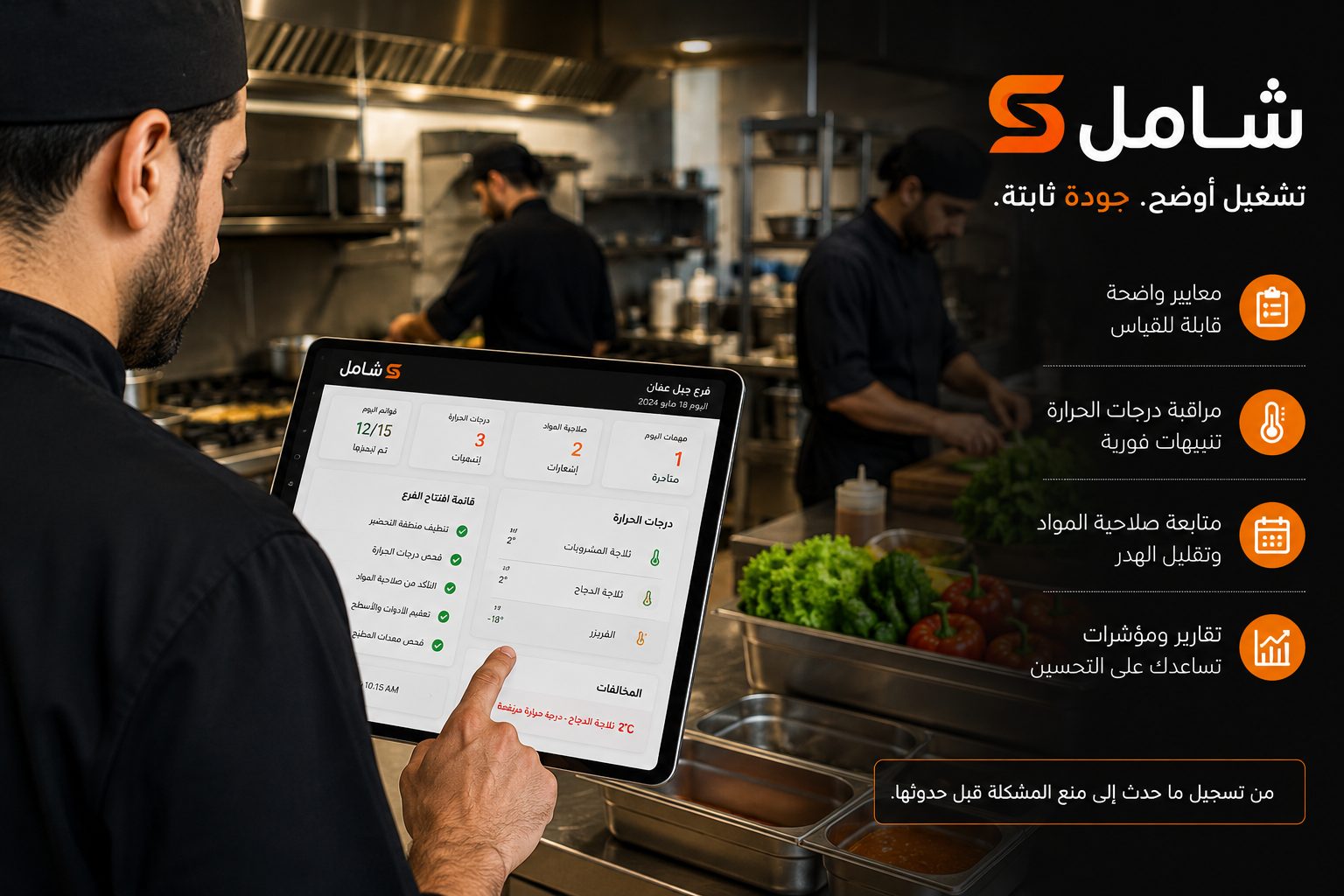
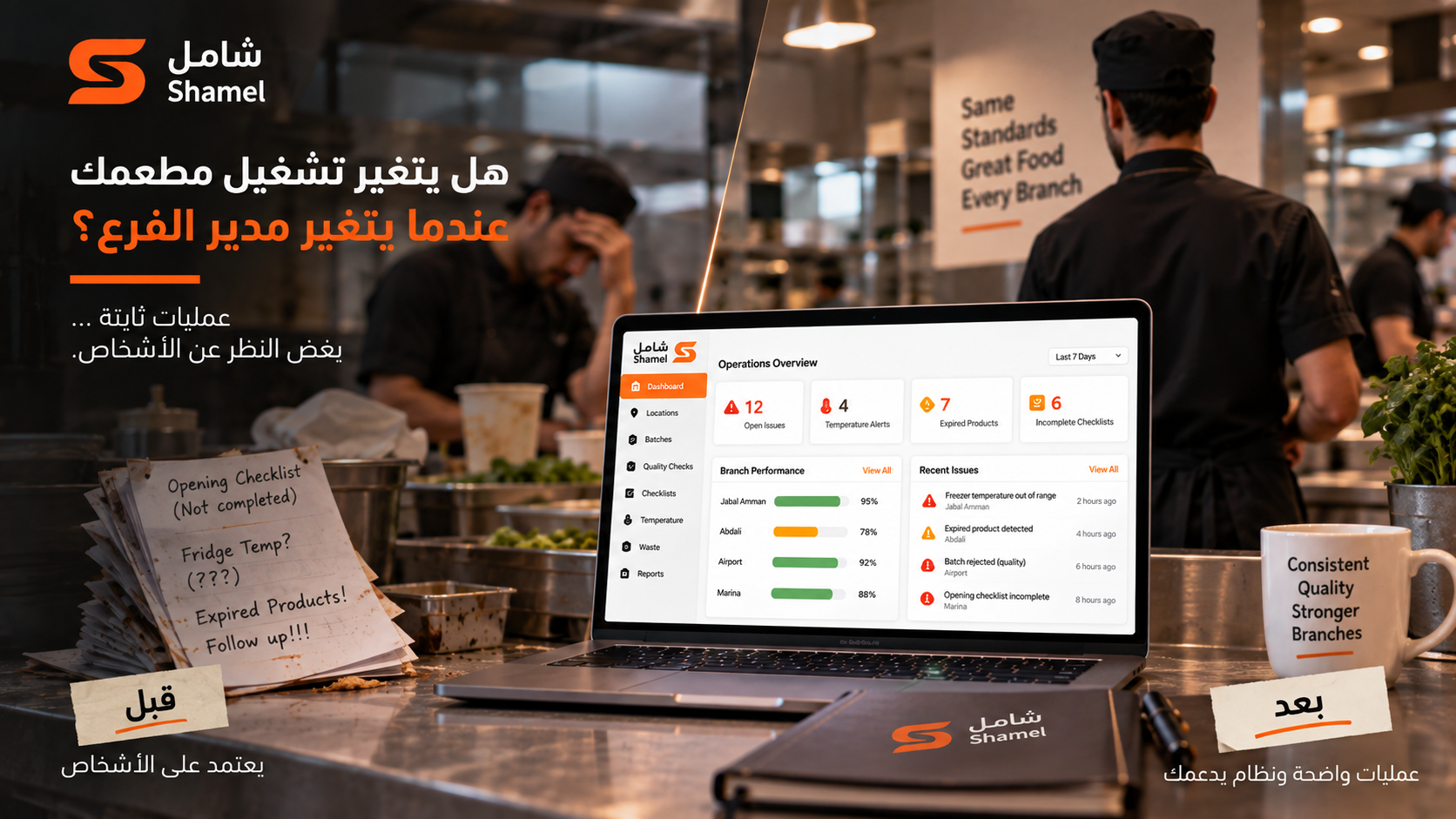
Shamel can connect the operational evidence already produced by restaurants—such as temperature records, tasks and checklists, receiving approvals or rejections, production quality checks, and operational violations—with branch visibility and reporting.
Instead of leaving a violation in a chat message or paper form, teams can use a structured record, assign follow-up through the appropriate operational workflow, and review patterns across branches. The quality team still decides the standard, product disposition, cause, action, and evidence required; the platform helps keep the information visible and traceable.
A simple implementation plan
Start with one high-value category, such as temperature deviations or rejected deliveries. Define the required fields, who can open and close an action, and what evidence is acceptable. Train branch managers using two or three real scenarios. Review open actions weekly for the first month, then refine categories and escalation rules based on what the records reveal.
The goal is not to create more paperwork. It is to make sure that a deviation leads to a controlled response, a responsible owner, and proof that the operation is back under control.
Frequently Asked Questions
What is the difference between a correction and a corrective action in a restaurant?
A correction controls the immediate issue, such as isolating food or rejecting a delivery. Corrective action addresses the likely cause, assigns responsibility, and verifies that the issue does not recur.
What should a restaurant corrective action plan include?
Include the deviation, required standard, affected product or process, immediate correction, likely cause, assigned action, owner, deadline, evidence, verification result, and closure approval.
When should a corrective action be closed?
Close it only after the assigned action is complete, supporting evidence is attached, and an authorized reviewer confirms that the action was effective.
Who should own corrective actions in a multi-branch restaurant?
Ownership depends on the cause, but one accountable person should be named. It may be the branch manager, quality manager, maintenance lead, central kitchen supervisor, or procurement manager.
Do all restaurant violations need a root-cause analysis?
No. A minor isolated issue may need only a documented correction. Repeated, high-risk, or cross-branch problems require deeper cause analysis and formal follow-up.