# Small Restaurant Problems Become Expensive When You Find Them Too Late
Most operational problems in restaurants don't begin as major incidents.
They start small.
A refrigerator records an abnormal temperature.
An employee misses a task.
A production batch gets rejected.
A product expires before it can be used.
Or a small quantity of food gets discarded.
Each incident may seem insignificant on its own.
The real problem begins when the same issue keeps happening without anyone noticing the pattern.
The Real Problem Isn't One Mistake
Imagine one location discards two kilograms of the same product this week.
It might look like an isolated incident.
But what if the same thing happened last week?
And the week before?
What if two other locations are experiencing the same issue?
Suddenly, you're no longer looking at two kilograms of waste.
You're looking at a recurring operational pattern that costs money every week.
The same principle applies to:
- Food waste.
- Temperature problems.
- Incomplete tasks.
- Rejected production batches.
- Product expiry.
- Inconsistent quality.
- Receiving problems between locations.
Small problems become expensive when they become part of everyday operations.
Why Are These Problems Difficult to See?
Because operational information is often scattered.
Some of it is on paper.
Some is in WhatsApp conversations.
Some is known by the branch manager.
Some is stored in spreadsheets.
And some incidents aren't recorded at all.
You may see each incident separately without seeing the connection between them.
Disconnected data tells you what happened. Connected data helps you understand what keeps happening.
Don't Wait for the Customer Complaint
Sometimes the first signal management receives is a customer complaint.
By that point, the operational problem has already reached the customer experience.
Ideally, earlier signals should be visible.
If the same product repeatedly fails quality checks, that's a signal.
If the same refrigerator repeatedly records abnormal temperatures, that's a signal.
If one location regularly misses its opening checklist, that's a signal.
If the same product expires and gets discarded every week, that's a signal.
Each one creates an opportunity to act before the problem becomes larger.
Recording a Problem Isn't the Same as Monitoring It
Keeping a record is useful.
But the record becomes much more valuable when it has context.
If a batch was rejected, management should be able to determine:
- Which product?
- Which location?
- When did it happen?
- Why was it rejected?
- Has the same reason appeared before?
- Is it connected to the same product or location?
Now the incident becomes useful operational information.
The same applies to temperature readings, waste, tasks, and expiry.
Focus on Exceptions
Management doesn't need to review everything that went right.
If 200 tasks were completed successfully today, that's good.
But knowing that five critical tasks weren't completed may be more important.
If 30 refrigerators are operating normally, you don't need to inspect every reading individually.
You need to know which one went outside its defined range.
And if 100 production batches passed quality checks, the rejected batches deserve more attention.
Effective operations management focuses attention on exceptions.
Connect Problems to Location, Product, and Time
Context makes recurring patterns easier to identify.
You might discover that:
Most waste comes from one product.
Or:
Abnormal temperature readings are concentrated at one location.
Or:
Certain batches are repeatedly rejected during receiving.
Or:
Opening checklists are frequently incomplete on particular days.
This allows management to move from:
"We have a problem."
to:
"We know where the problem is happening and what needs investigation."
Recurring Problems Are Opportunities to Improve
The purpose of tracking problems isn't to find someone to blame.
It's to improve the process.
When the same issue keeps happening, ask:
- Is the procedure clear?
- Is training sufficient?
- Is the equipment working correctly?
- Is the production quantity appropriate?
- Is preparation timing right?
- Is ownership clear?
- Does the process itself need to change?
Fixing one small recurring issue can sometimes create more long-term value than cutting a large one-time expense.
Because the improvement continues every day afterward.
How Shamel Helps
This is where Shamel fits.
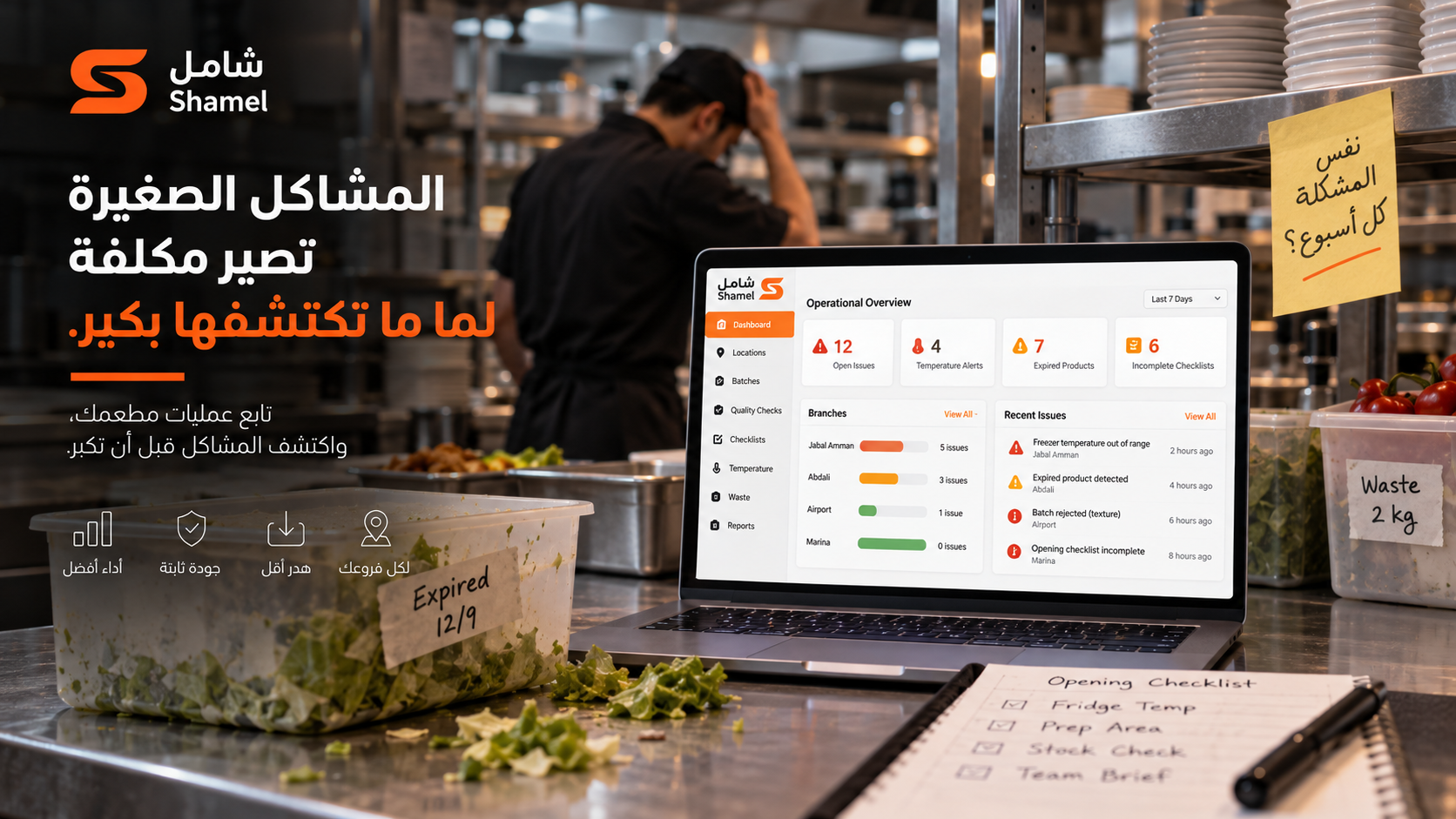
Shamel connects the daily restaurant processes that can reveal where operational problems begin.
Teams can manage and monitor:
- Production batches.
- Quality checks and approvals.
- Receiving and rejection.
- Temperature readings.
- Product expiry.
- Tasks and checklists.
- Operational violations.
- Waste and discarded products.
- Location performance.
When something goes wrong, there is a clearer record of what happened, where it happened, and when.
As operational data builds over time, recurring patterns become easier to identify.
From Recording What Happened to Seeing What's Happening
There's a major difference between a system that tells you what happened at the end of the month and one that helps surface what needs attention during operations.
The goal isn't to give restaurant operators another dashboard to watch all day.
The goal is to quickly understand:
Where is the problem?
What keeps happening?
Where should I intervene?
The earlier an operational problem becomes visible, the easier it is to address before it affects waste, quality, or the customer experience.
Don't Wait Until Everyone Can See the Problem
If you manage multiple locations, you can't be present in every kitchen and every shift.
But you can build an operating process that makes important problems visible.
Shamel helps restaurants turn daily operations into clearer operational data and identify recurring issues before they become bigger problems.
Book a Free Shamel Demo
If you manage multiple restaurant locations and want clearer visibility into operational problems, book a free Shamel demo and see how your operations can be monitored from one place.